By AI Power Marketing
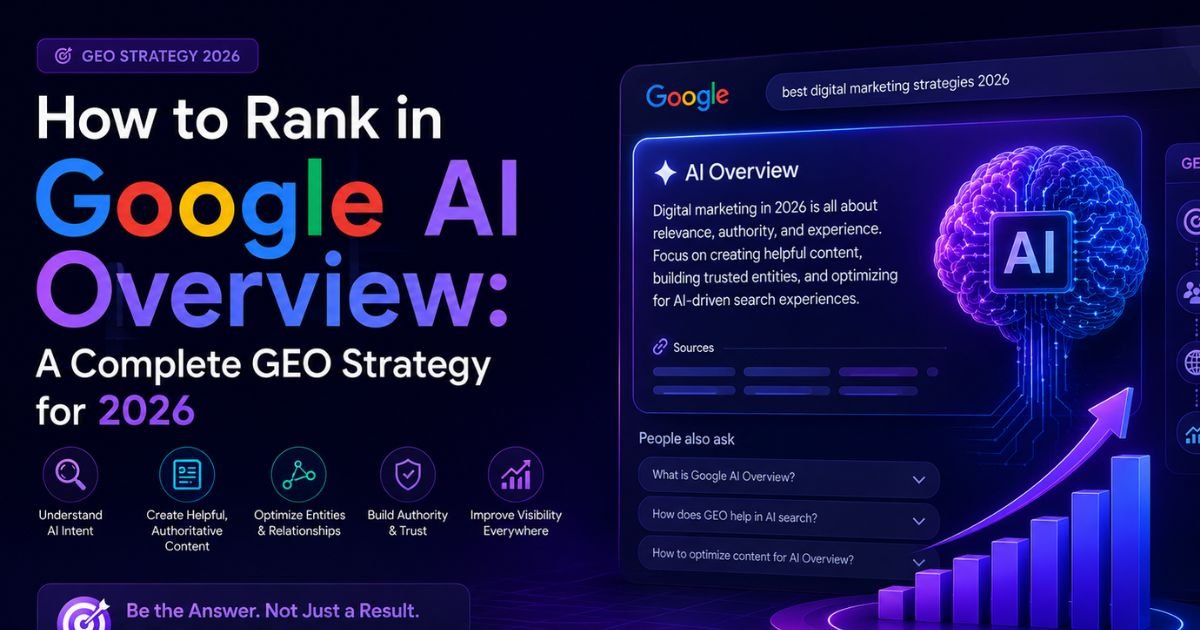
Google AI Overviews now show up on a large and growing share of searches, and they’ve changed what “ranking #1” actually means. It’s no longer enough to land on page one — you need to become the passage Google’s AI actually pulls into the answer box. That’s the core idea behind Generative Engine Optimization (GEO), and it’s what this guide walks you through.
If you’ve been asking how to rank in Google AI Overview, the short answer is: rank organically first, then structure your content so it’s impossible for Google’s AI to ignore.
Key Takeaway
- AI Overviews pull from Google’s existing organic index — there’s no separate “AI crawler.” Traditional SEO is still the entry ticket.
- The unit of optimization has shifted from the page to the passage. A short, self-contained, factual paragraph can win a citation even from a page ranking outside the top 3.
- Structure (clear H2/H3s, lists, definitions), schema markup, topical authority, and content freshness are the four biggest levers for AI Overview optimization.
- Track your “AI Overview share of voice” — how often your brand is cited — as a core visibility metric alongside rankings.
What Are Google AI Overviews, and Why Do They Matter?
Google AI Overviews are the AI-generated summary boxes that appear above traditional search results. Instead of scanning ten blue links, users get a synthesized answer built from multiple sources, with citation chips linking back to the original pages.
For businesses and marketers, this is a big shift in AI SEO priorities. Ranking #1 organically used to guarantee the lion’s share of clicks. Now, when an AI Overview appears above your listing, click-through rates on that top spot can drop dramatically, because a chunk of searchers get their answer without clicking through at all.
That makes AI Overview optimization less optional and more foundational. If your content isn’t structured to be cited, you’re invisible in the exact spot where more and more searches now get resolved.
How Google Decides What to Cite
Understanding the mechanics is the first step in any real GEO strategy. A few things worth internalizing:
- AI Overviews are built on top of Google’s normal web index. There’s no parallel “AI crawler” ranking pages differently. If your page isn’t eligible to rank organically, it’s not eligible to be cited.
- The passage, not the page, is what gets selected. Google’s generative layer looks for the clearest, most self-contained paragraph that answers a specific sub-question. A page ranking #4 with one excellent, tightly-written paragraph can beat a #1 page with a sprawling, unfocused intro.
- Newer or smaller sites still have a shot. AI Overviews don’t always cite the top-ranking domains — quality, clearly structured content from a newer site can still get picked up.
- Freshness is weighted. Google’s AI systems appear to favor recently updated content, and the “last updated” date is often visible right in the citation.
10 Ways to Rank in Google AI Overview
1. Match Content Format to Search Intent
Before writing anything, search your target keyword and study what’s already ranking. Is Google showing listicles, comparison tables, step-by-step guides, or long-form explainers? Don’t fight the format Google has already decided works for that intent — match it.
2. Write Extractable, Self-Contained Passages
This is the single biggest shift from classic SEO. Every key section should have at least one paragraph that could stand alone as a complete answer — no pronouns referring back three paragraphs, no “as mentioned above.” Lead with the answer, then explain.
3. Add a “Key Takeaway” or TL;DR Section
Summarizing your main point in 2–4 bullet points near the top gives Google’s AI a ready-made, high-confidence passage to lift. It also improves readability for human visitors who are scanning.
4. Structure Content for Machine Readability
Use a clean hierarchy: H2 for core topics, H3 for supporting subtopics, and bulleted or numbered lists for discrete facts, steps, or comparisons. The easier your content is to scan, the easier it is for an AI system to reuse it.
5. Answer the Specific Sub-Question, Not Just the Broad Topic
Big queries usually break down into several sub-questions. Rather than writing one generic section on “AI SEO,” break your content into the specific questions people actually ask — pricing, timelines, tools, risks — and answer each one directly and completely.
6. Implement Structured Data (Schema Markup)
Schema is one of the strongest machine-readable eligibility signals you can add. FAQ schema, HowTo schema, and Article schema all help Google’s systems understand exactly what your content is and where the answers live.
7. Build Topical Authority Through Internal Linking
Google’s AI evaluates authority partly through how well a page is linked from related content on your own site. A page that’s clearly the hub of a well-linked topic cluster signals that it’s the definitive treatment of that subject on your domain.
8. Keep Content Fresh on a Set Cadence
Set a quarterly review cycle for your priority pages: update statistics, refresh examples, and republish with a visible new date. Since the update timestamp is often shown in the citation itself, recency isn’t just a ranking signal — it’s a trust signal for readers too.
9. Build Source Credibility Beyond Your Own Site
Google’s AI Overview system evaluates the credibility of a source, not just the content on the page. Author bios, cited data sources, and a track record of accurate, well-sourced content all feed into this.
10. Track Your AI Overview Share of Voice
Don’t just track keyword rankings — start measuring how often your brand actually appears inside AI Overviews for your priority queries. This “AI Overview share of voice” is becoming one of the clearest visibility metrics for judging whether your GEO strategy is working.
AI Overview Optimization vs. Traditional SEO: What Actually Changes
| Traditional SEO | AI Overview Optimization (GEO) |
|---|---|
| Optimize the page to rank | Optimize the passage to get cited |
| Success = position on page 1 | Success = citation inside the AI answer |
| Keyword density and backlinks | Extractability, structure, and entity clarity |
| One-time optimization | Ongoing freshness and re-publishing cadence |
The takeaway: classic SEO isn’t dead — it’s the entry ticket. You still need to rank well enough to be in Google’s index of trusted candidates. But ranking alone no longer guarantees visibility, because a competitor with a cleaner, more directly extractable paragraph can win the citation instead.
Common Mistakes That Keep Content Out of AI Overviews
- Burying the answer. If your key point is in paragraph six after three paragraphs of backstory, it’s much harder for Google’s AI to extract cleanly.
- Vague, generic paragraphs. Passages that hedge or ramble don’t get selected over ones that state a clear, confident, factual answer.
- No structured data. Skipping schema markup leaves an easy signal on the table.
- Letting content go stale. Outdated stats and examples reduce the odds of citation, especially for fast-moving topics.
- Ignoring sub-questions. Covering only the broad topic, without addressing the specific angles people search for, limits how many “citation opportunities” your page can win.
FAQ: Ranking in Google AI Overviews
Does AI Overview optimization replace SEO? No. AI Overviews are built from Google’s existing organic index, so ranking well organically is still required. GEO adds a structural and formatting layer on top of solid SEO fundamentals.
Can a new website get cited in AI Overviews? Yes. AI Overviews don’t always cite the top-ranking domains — clearly structured, credible content from a newer site can still be selected if it answers a sub-question more precisely than the competition.
How often should I update content for AI Overview visibility? A quarterly refresh cadence for your priority pages is a reasonable starting point — updating statistics, examples, and the published date.
What’s the difference between GEO and AI SEO? They’re largely used interchangeably. Both describe the practice of structuring content so generative AI systems (Google AI Overviews, AI Mode, and other AI search tools) can extract and cite it accurately.
Final Thoughts
Ranking in Google AI Overview isn’t a separate discipline from SEO — it’s SEO’s next layer. Rank well organically, then restructure your best content around clear, self-contained, citable passages, back it with schema and internal links, and keep it fresh. Do that consistently, and you put your brand in the position that matters most in 2026 search: not just on the results page, but inside the answer itself.
Want help building a GEO strategy tailored to your site? AI Power Marketing helps brands get structured, cited, and found inside Google AI Overviews and AI-driven search. Get in touch to see where your content stands today.