If you’ve been searching for clarity on AEO vs GEO vs SEO, you’re not alone. Every business owner, marketer, and website manager is asking the same question right now: is traditional SEO enough, or do I also need Answer Engine Optimization and Generative Engine Optimization to stay visible?
The short answer: you need all three working together. Search behavior has changed. People still type queries into Google, but a growing share of those queries are now answered directly — by AI Overviews, by ChatGPT, by Perplexity, by voice assistants — without a single click to a website. Understanding AEO vs GEO vs SEO isn’t optional anymore; it’s the foundation of any visibility strategy in 2026.
At AI Powered Marketing, we work with this shift every day — helping brands rank in classic search results while also getting cited inside AI-generated answers. This guide breaks down exactly what each discipline does, how they differ, and how to build a strategy that covers all three.
What is SEO?
Search Engine Optimization (SEO) is the practice of improving a website so it ranks higher in traditional search engine results — primarily Google, but also Bing and others. SEO has been the backbone of digital marketing for over two decades and includes:
- Technical SEO – site speed, crawlability, indexing, mobile-friendliness, structured data
- On-Page SEO – keyword optimization, headings, meta titles/descriptions, internal linking
- Off-Page SEO – backlinks, brand mentions, digital PR, authority building
SEO’s goal is simple: get a user to click on your blue link and land on your website. It remains the foundation that both AEO and GEO are built on top of — without solid SEO fundamentals, the other two won’t work.
What is AEO?
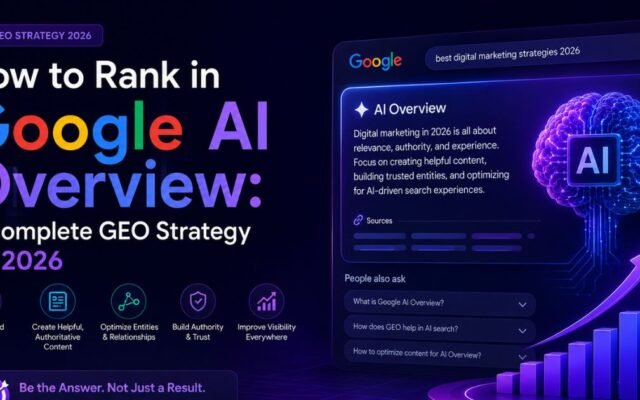
What is AEO, exactly? Answer Engine Optimization is the practice of structuring content so it gets pulled out and shown as a direct answer — inside Google’s featured snippets, “People Also Ask” boxes, voice search responses, and AI Overviews. Instead of competing purely for a ranking position, AEO competes for the answer slot itself.
AEO relies heavily on:
- Clear, concise question-and-answer formatting
- FAQ schema and structured data markup
- Short, direct answers placed near the top of a page, followed by depth
- Conversational, natural-language phrasing that matches how people actually ask questions
AEO doesn’t replace SEO — it builds on it. A page still needs to be crawlable, fast, and authoritative before an answer engine will ever consider surfacing it.
What is GEO?
What is GEO, or Generative Engine Optimization, is the newest and least understood of the three. GEO focuses on making your content usable, trustworthy, and citation-worthy for generative AI systems like ChatGPT, Claude, Gemini, and Google AI Overviews. When an AI model generates an answer, it’s synthesizing information from many sources — GEO is about making sure your brand is one of the sources it pulls from and cites.
This is fundamentally different from ranking. GEO SEO work involves:
- Building topical authority through comprehensive, well-organized content
- Using clear entity definitions (who you are, what you do, where you operate)
- Publishing original data, research, or expertise that AI models find “citation-worthy”
- Structured data and clean technical implementation so AI crawlers can parse your content easily
- Consistent, accurate brand information across the web (a strong E-E-A-T signal)
Think of GEO as AI SEO — optimizing not just for search engine bots, but for large language models that generate answers on your behalf, often without ever sending the user to your website.
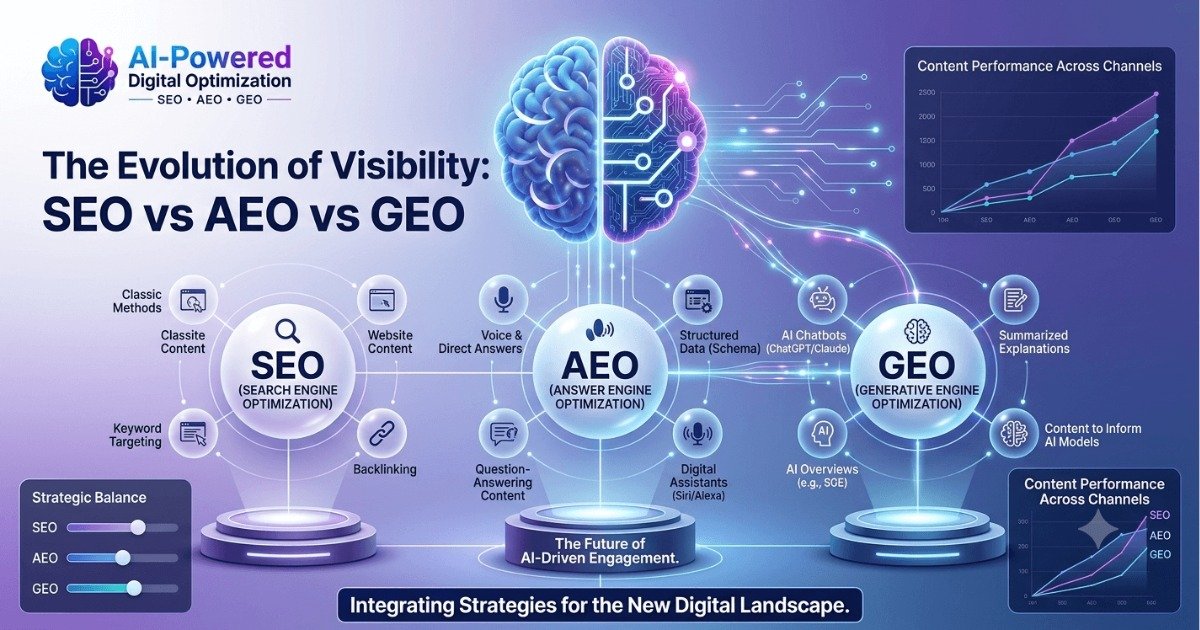
AEO vs GEO vs SEO: Key Differences
The debate around AEO vs GEO vs SEO usually comes down to one core distinction: where does the user end up?
- SEO sends the user to your website via a ranked link.
- AEO gets your content shown as the answer, often on the search results page itself.
- GEO gets your content used inside an AI-generated response, sometimes with a citation, sometimes without a click at all.
None of these three replace each other. In fact, most of the technical groundwork overlaps — a technically sound, authoritative, well-structured website supports all three simultaneously.
Comparison Table: SEO vs AEO vs GEO
| Factor | SEO | AEO | GEO |
|---|---|---|---|
| Full Form | Search Engine Optimization | Answer Engine Optimization | Generative Engine Optimization |
| Primary Goal | Rank on search engine result pages | Become the direct answer (snippet, voice, PAA) | Get cited/used by AI-generated responses |
| Target Platforms | Google, Bing | Featured snippets, AI Overviews, voice assistants | ChatGPT, Claude, Perplexity, Gemini, AI Overviews |
| Core Tactics | Keywords, backlinks, technical health | Schema markup, Q&A formatting, concise answers | Topical authority, entity clarity, original data |
| Success Metric | Rankings, organic traffic | Snippet/answer box visibility | Citations, brand mentions in AI answers |
| Click Behavior | Drives clicks to your site | Sometimes zero-click | Often zero-click |
| Foundation Required | Crawlability, indexing, relevance | Strong SEO base | Strong SEO + AEO base |
Why You Need SEO, AEO, and GEO Together
Choosing between AEO vs GEO vs SEO is the wrong framing. The businesses gaining visibility in 2026 aren’t picking one — they’re integrating all three into a single content and technical strategy. Here’s why:
- SEO builds the trust foundation. Without crawlable, fast, well-structured pages, neither answer engines nor generative engines will trust your content enough to surface it.
- AEO captures the “instant answer” moment. A large share of searches are now resolved without a click — if your content isn’t structured to be extracted, you lose that visibility entirely.
- GEO future-proofs your brand. As more people turn to AI chat tools instead of traditional search bars, being the source an AI model cites becomes a new form of brand authority — one that’s much harder for competitors to buy their way into with ads.
At AI Powered Marketing, our approach blends all three layers — technical SEO audits, AEO-ready content formatting, and GEO-focused authority building — so our clients show up whether the user is scrolling ten blue links or asking an AI assistant a direct question.
FAQs on AEO vs GEO vs SEO
Q1: Is GEO replacing SEO?
No. GEO builds on top of SEO. Generative engines still rely on many of the same signals — authority, relevance, technical health — that traditional search algorithms use. Without strong SEO, GEO has nothing solid to build on.
Q2: What is AEO used for if Google already shows AI Overviews?
AEO is exactly what helps you get selected inside those AI Overviews, featured snippets, and voice search answers. It’s the bridge between traditional SEO and full GEO strategy.
Q3: Does GEO SEO require different content than regular SEO content?
Not entirely different — but it does require more depth, clearer entity definitions, original insights, and better structural clarity so AI systems can confidently extract and cite your information.
Q4: How do I measure GEO success if there are no clicks?
Track AI citation appearances, brand mentions inside AI-generated answers, referral traffic from AI platforms, and branded search volume — these are the new KPIs alongside traditional rankings.
Q5: Which should a small business prioritize first — SEO, AEO, or GEO?
Start with strong technical and on-page SEO, layer in AEO through FAQ schema and structured answers, then build GEO through authoritative, in-depth content. Trying to skip straight to GEO without an SEO foundation rarely works.
Q6: Is “AI SEO” the same thing as GEO?
Largely yes — “AI SEO” is often used informally to describe the same practice as Generative Engine Optimization: optimizing content so AI models trust and cite it.
Conclusion
The conversation around AEO vs GEO vs SEO isn’t about picking a winner — it’s about recognizing that search itself has expanded into three interconnected layers: ranking, answering, and generating. A brand that only optimizes for one is leaving visibility on the table across the other two.
At AI Powered Marketing, we help brands build exactly this kind of integrated visibility — combining technical SEO, answer-ready content, and generative engine authority into one strategy. If you’re looking to strengthen your foundation with a team that understands AEO vs GEO vs SEO as one connected discipline rather than three separate silos, working with the Best SEO Agency in Dehradun is the right place to start.